Another Successful Heat Siphon Installation
Heat Siphon Z575 new installation in Memphis Tennessee. Heat pumps has been running since the beginning of March in a cold weather state. This system can be used when you have a lake, pond, well, or an adequate supply of suitable water is available. The heat from that water source will be collected, concentrated with a heat pump and then applied into your home via radiant/hydronic floor heating. Just like the water to water systems, water to air geothermal pool heating systems are also known either as Open Loop or Closed Loop. The advantage of an open loop (existing well or lake on the property) versus a closed loop system (buried pipes) is that with the open loop the upfront investment can be much less than in a closed loop geothermal system as you have less materials, less construction, earth excavation and as a result, there are less labor costs. There is also the option of pond loops. Pond loops can utilize the water to transfer to and from the pond. A coiled pipe is installed into the pond which should cover about 1/2 acre. Reduced installation costs and high performance are characteristics of this type of loop.
You then have the aforementioned "closed" loops. These can be vertical or horizontal. Vertical loops are primarily used when land area is limited or ground conditions are not suitable digging horizontal trenches. the loop is then inserted into the vertical bore hole in the ground that averages between 150'-300' deep per ton. These holes are then backfilled. Horizontal loops are primarily used when the soil conditions allow for low cost excavation. However, they do take up more land area than any other loop type. Trenches are normally 4'-6' deep with multiple pipe loops placed in the trenches at different depths.
This system can be used when you have a lake, pond, well, or an adequate supply of suitable water is available. The heat from that water source will be collected, concentrated with a heat pump and then applied into your home via radiant/hydronic floor heating. Just like the water to water systems, water to air geothermal pool heating systems are also known either as Open Loop or Closed Loop. The advantage of an open loop (existing well or lake on the property) versus a closed loop system (buried pipes) is that with the open loop the upfront investment can be much less than in a closed loop geothermal system as you have less materials, less construction, earth excavation and as a result, there are less labor costs. There is also the option of pond loops. Pond loops can utilize the water to transfer to and from the pond. A coiled pipe is installed into the pond which should cover about 1/2 acre. Reduced installation costs and high performance are characteristics of this type of loop.
You then have the aforementioned "closed" loops. These can be vertical or horizontal. Vertical loops are primarily used when land area is limited or ground conditions are not suitable digging horizontal trenches. the loop is then inserted into the vertical bore hole in the ground that averages between 150'-300' deep per ton. These holes are then backfilled. Horizontal loops are primarily used when the soil conditions allow for low cost excavation. However, they do take up more land area than any other loop type. Trenches are normally 4'-6' deep with multiple pipe loops placed in the trenches at different depths.
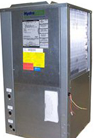 This system can be used when you have a lake/pond, loop system or well, or where an adequate supply of suitable water is available. The heat from that water source will be collected, concentrated with a heat pump and then applied it on to your home through an ecologically friendly forced air heating and cooling system.
Just like the water to water systems, water to air geothermal pool heating systems are also known either as Open Loop or Closed Loop. The advantage of an open loop (existing well or lake on the property) versus a closed loop system (buried pipes) is that with the open loop the upfront investment can be much less than in a closed loop geothermal system as you have less materials, less construction, earth excavation and as a result, there are less labor costs. There is also the option of pond loops. Pond loops can utilize the water to transfer to and from the pond. A coiled pipe is installed into the pond which should cover about 1/2 acre. Reduced installation costs and high performance are characteristics of this type of loop.
You then have the aforementioned "closed" loops. These can be vertical or horizontal. Vertical loops are primarily used when land area is limited or ground conditions are not suitable digging horizontal trenches. the loop is then inserted into the vertical bore hole in the ground that averages between 150'-300' deep per ton. These holes are then backfilled. Horizontal loops are primarily used when the soil conditions allow for low cost excavation. However, they do take up more land area than any other loop type. Trenches are normally 4'-6' deep with multiple pipe loops placed in the trenches at different depths.
This system can be used when you have a lake/pond, loop system or well, or where an adequate supply of suitable water is available. The heat from that water source will be collected, concentrated with a heat pump and then applied it on to your home through an ecologically friendly forced air heating and cooling system.
Just like the water to water systems, water to air geothermal pool heating systems are also known either as Open Loop or Closed Loop. The advantage of an open loop (existing well or lake on the property) versus a closed loop system (buried pipes) is that with the open loop the upfront investment can be much less than in a closed loop geothermal system as you have less materials, less construction, earth excavation and as a result, there are less labor costs. There is also the option of pond loops. Pond loops can utilize the water to transfer to and from the pond. A coiled pipe is installed into the pond which should cover about 1/2 acre. Reduced installation costs and high performance are characteristics of this type of loop.
You then have the aforementioned "closed" loops. These can be vertical or horizontal. Vertical loops are primarily used when land area is limited or ground conditions are not suitable digging horizontal trenches. the loop is then inserted into the vertical bore hole in the ground that averages between 150'-300' deep per ton. These holes are then backfilled. Horizontal loops are primarily used when the soil conditions allow for low cost excavation. However, they do take up more land area than any other loop type. Trenches are normally 4'-6' deep with multiple pipe loops placed in the trenches at different depths.
This combined system can be used when you have a lake/pond, underground loop system or well. Also anywhere an adequate supply of suitable water is available. The heat from that water source will be collected, concentrated with the heat pump and then applied it on to your home through an ecologically friendly forced air heating and cooling system combined with hydronic / radiant floor heating!You get the best of both worlds
Just like the water to water systems, water to air geothermal pool heating systems are also known either as Open Loop or Closed Loop. The advantage of an open loop (existing well or lake on the property) versus a closed loop system (buried pipes) is that with the open loop the upfront investment can be much less than in a closed loop geothermal system as you have less materials, less construction, earth excavation and as a result, there are less labor costs. There is also the option of pond loops. Pond loops can utilize the water to transfer to and from the pond. A coiled pipe is installed into the pond which should cover about 1/2 acre. Reduced installation costs and high performance are characteristics of this type of loop.